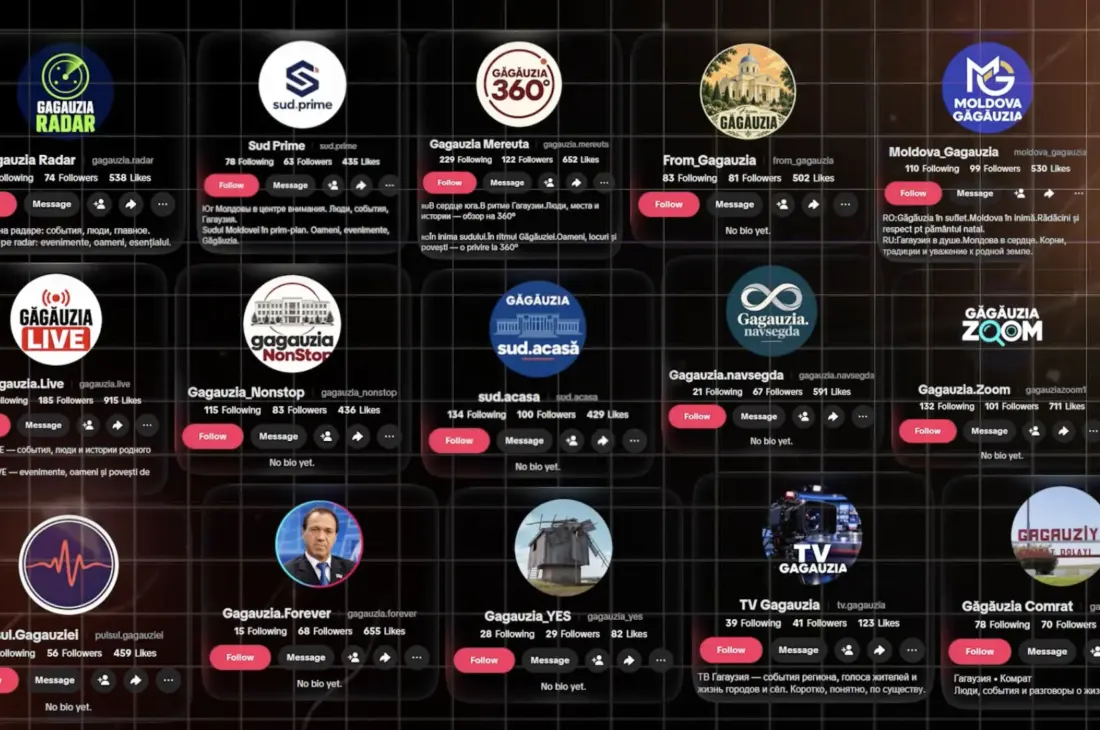
TikTok accounts in Gagauzia, some created on the very day the election campaign began, are promoting Fiodor Gagauz, the Socialist Party-backed candidate for governor (bashkan) of the autonomous region. The 20 anonymous profiles identified in an investigation accumulated more than 145,000 views, approximately 500 comments and over 3,400 shares in just six days. Repeated publication of identical videos, shared hashtags and interactions between the accounts suggest possible coordinated inauthentic behaviour, according to an analysis by Watchdog.
The election campaign for governor of Gagauzia appears to have moved, at least partly, from traditional campaigning to TikTok.
At the centre of this online activity is Fiodor Gagauz, the candidate supported by the Party of Socialists of the Republic of Moldova (PSRM).
The analysis identified 20 anonymous accounts systematically distributing videos favourable to the candidate. Some were created on the same day, just minutes apart, and subsequently began publishing similar content and interacting with one another.
Their activity raises questions about how online electoral promotion is organised and whether the resources potentially involved are being transparently disclosed.
TikTok Accounts in Gagauzia: How the Campaign Activity Began
On October 16, 2026, the day the election campaign began, several TikTok accounts appeared with names referring to Gagauzia and southern Moldova.
The first identified profile, “Găgăuzia Forever,” was created at 5:38 p.m.
At 6:00 p.m., “Moldova Găgăuzia” appeared, followed by “Pulsul Găgăuziei” at 6:11 p.m.
Just one minute later, another account, “Găgăuzia Mereuță,” was created.
At 6:53 p.m., “Sud Acasă” appeared, followed two minutes later by “Găgăuzia Non-stop.”
The sequence continued at 7:23 p.m. with “Găgăuzia Navsegda,” and at 8:04 p.m. with “Găgăuzia Zoom.”
Additional accounts were identified over the following days, bringing the total number of profiles examined to 20.
Their names follow a similar pattern, including “Găgăuzia Forever,” “Găgăuzia Navsegda,” “Găgăuzia Live,” “Găgăuzia Radar,” “Sud Prime” and other combinations featuring the words “Gagauzia” or “South.”
The creation of multiple accounts within a short period does not, by itself, prove the existence of a coordinated network.
However, similarities in their subsequent activity become more apparent when examining the content they published.
Identical Videos Shared Across Multiple Profiles
One of the most visible similarities is the repeated distribution of the same videos.
For example, an excerpt from an interview Fiodor Gagauz gave to journalist Gheorghe Gonța appeared on several of the identified accounts.
Another video featuring the Socialist candidate alongside PSRM leader Igor Dodon was distributed in a similar manner.
The recording appeared on profiles including “Găgăuzia Forever,” “Pulsul Găgăuziei,” “Găgăuzia Zoom,” “Găgăuzia Navsegda,” “Găgăuzia Non-stop,” “Găgăuzia Live,” “From Găgăuzia,” “Găgăuzia Mereuță,” and “Sud Prime,” among others.
The same pattern was observed with videos showing Fiodor Gagauz during campaign activities in communities across the autonomous region.
In some cases, posts featured nearly identical captions and the same hashtags.
These hashtags included the candidate’s name and the region’s name, making the videos easier to discover for users interested in the election.
Publishing identical content across multiple accounts can amplify electoral messages and increase their overall visibility.
Anonymous Accounts Follow and Comment on One Another
The analysis of the 20 TikTok accounts in Gagauzia found that similarities extended beyond the videos themselves.
Most of the identified profiles followed one another.
Some reposted material from other accounts within the group, as well as posts from a profile believed to belong to Fiodor Gagauz.
The accounts also interacted through comments.
For example, a post published by “Găgăuzia Live” received comments from “Găgăuzia Mereuță,” “Moldova Găgăuzia” and “Găgăuzia Radar.”
In another case, a post on “Găgăuzia Zoom” received comments from other accounts included in the analysis, including “Găgăuzia Live.”
Such interactions may increase the visibility of posts and extend the reach of electoral messages.
The combination of identical content, similar captions and reciprocal engagement is consistent with possible coordinated inauthentic behaviour.
However, these observations do not establish who operates the accounts, whether they share a common coordinator or whether their activity is organised by the candidate’s campaign team.
More Than 145,000 Views in Just Six Days
By October 21, 2026, when the analysis was documented, the 20 identified accounts had collectively accumulated the following engagement figures:
| Metric | Total |
|---|---|
| Anonymous TikTok accounts | 20 |
| Video views | Over 145,000 |
| Comments | Approximately 500 |
| Shares | Over 3,400 |
| Period examined | Six days |
These figures were recorded over a relatively short period.
The scale of the audience is notable given that Gagauzia has slightly more than 100,000 residents.
However, the number of views should not be confused with the number of individual people who watched the videos.
A single user can watch multiple videos or generate multiple views.
The available data also does not establish how many viewers were actually located in Gagauzia.
Despite these limitations, the figures indicate substantial distribution of content favourable to the Socialist-backed candidate.
Who Is Behind the Promotion of Fiodor Gagauz?
Managing multiple TikTok accounts involves selecting videos, preparing captions, publishing content and interacting with users.
These activities require time and resources.
This raises questions about who operates the profiles and whether any financial resources are involved in their activity.
During election campaigns, promotional expenses must be declared under the applicable electoral legislation when they are incurred for the benefit of an electoral contestant and can be attributed to that campaign.
Anonymous accounts make it more difficult to identify administrators and potential funding sources.
It remains unclear whether the profiles are operated by volunteers, whether paid personnel are involved or whether there is a shared organisational structure.
Importantly, the available findings do not establish a direct financial or organisational connection between these accounts and Fiodor Gagauz or the Party of Socialists.
Further clarification could help determine whether the online promotion represents independent activity by supporters or an organised electoral campaign operation.
TikTok and Elections: Similar Patterns in Previous Campaigns
Political promotion through anonymous social media accounts is not unique to Gagauzia.
In Romania, the use of TikTok during the presidential campaign of Călin Georgescu generated controversy over the transparency of political promotion and the influence of digital platforms on electoral processes.
Similar concerns emerged in Moldova during the 2025 parliamentary elections.
At that time, anonymous TikTok accounts helped distribute content favourable to the Democracy at Home Party, accumulating millions of views.
These precedents do not demonstrate that the accounts promoting Fiodor Gagauz operate through the same mechanisms or share the same origins.
They do, however, illustrate how social media platforms have become important tools for electoral communication, including through accounts whose operators are not publicly identified.
What the 20 TikTok Accounts in Gagauzia Reveal
The analysis identified several common characteristics among the profiles promoting Fiodor Gagauz:
- Accounts created within a short period, including on the first day of the campaign.
- Repeated publication of identical campaign videos.
- Similar captions and hashtags.
- Reciprocal following, reposting and commenting.
- More than 145,000 views and 3,400 shares over six days.
Taken together, these findings suggest a possible coordinated effort to amplify electoral messages.
At the same time, the evidence presented does not identify the individuals behind the accounts or establish that they receive funding from a common source.
The central unanswered question is who manages these profiles and whether the promotion of the Socialist-backed candidate is organised outside official electoral expenditure reporting mechanisms.
The findings highlight the importance of transparency in digital campaigning, particularly when anonymous accounts are used to distribute political content at scale.
Source: Watchdog analysis, based on TikTok activity documented through October 21, 2026.